How Setting Holistic Health Goals Improves Your Physical Therapy Outcomes
My favorite part of every initial evaluation is getting to know my patient as an individual, including their goals, expectations, concerns, and the values that led them to enter the clinic. Take two patients, both experiencing chronic low back pain: one wants to get down on the floor to play with their grandchildren and the other wants to return to competitive martial arts. Their overall plan of care may look similar on paper, but their individual goals, prescribed interventions, and recovery trajectories can differ greatly.
In addition to physical therapy-specific goals, I am always curious to learn about my patients’ holistic health goals beyond the clinic. For example, things like nutrition, stress management, sleep, weight management, social participation, and more. As physical therapists, we understand your rehabilitation prognosis is influenced by biological, psychological, and social factors both within and beyond your control. We want to help optimize every aspect of your wellbeing so you can have the best physical therapy outcomes and personal wellness possible.
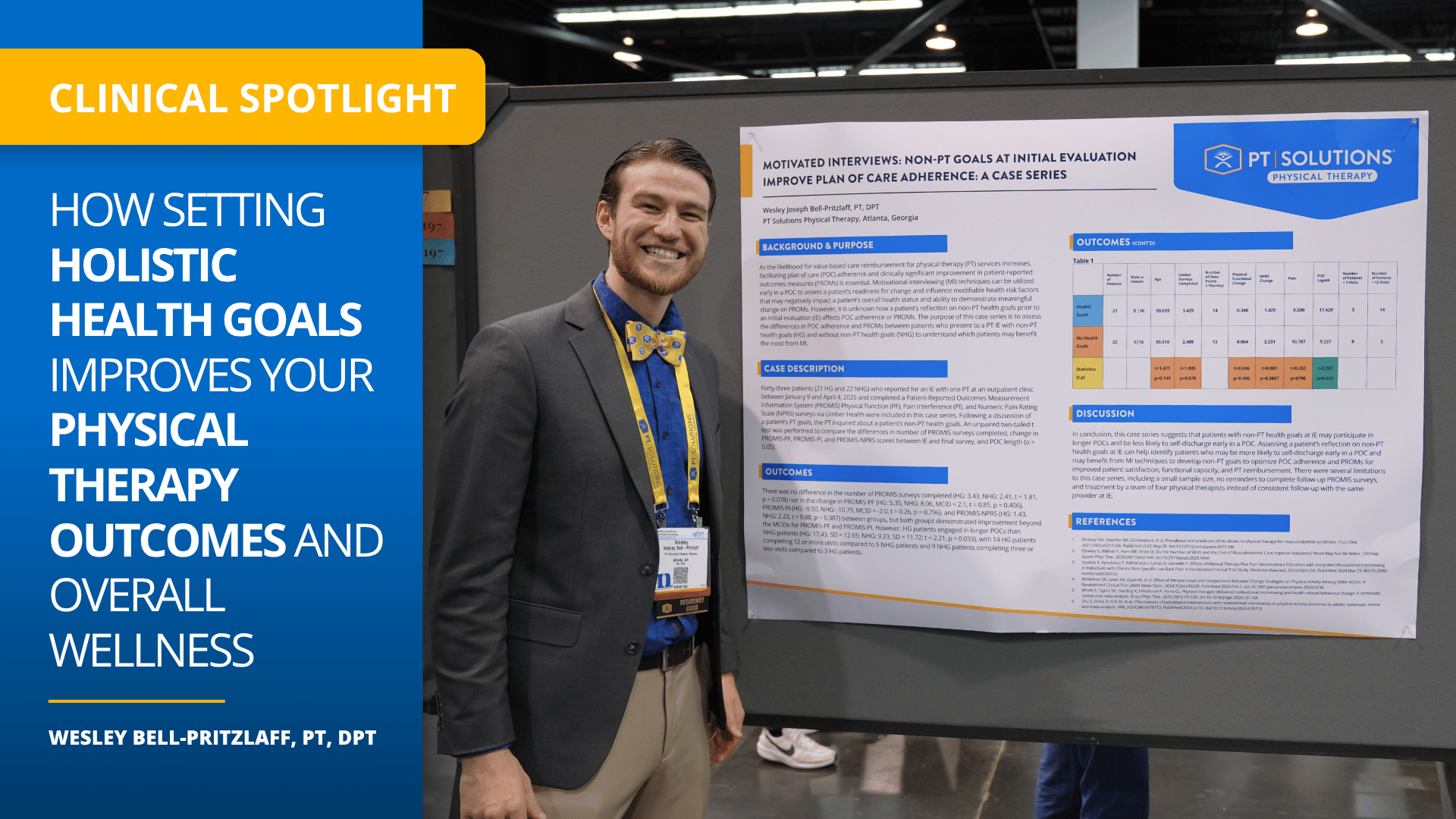
As I worked with patients to understand their goals, I noticed that many did not have health goals extending beyond physical therapy. This made me curious: does reflecting on non-physical therapy health goals before a first visit influence their participation in their plan of care and their outcomes in physical therapy? To find out, I conducted a case series research project that I recently presented at the Combined Sections Meeting (CSM), one of the largest annual gatherings of physical therapy professionals in the country.
Why Your Goals Matter in Physical Therapy
I always tell my patients: “Your goals are my goals.” Through shared decision-making, we work together to determine the best course of action and how your treatment will progress. At every follow-up session, I ask: “What are your priorities today? What do you hope to accomplish?” Setting an intention for each visit helps you and your physical therapist make the most of your time together, not just for symptom management, but for building your autonomy, confidence, and motivation.
Your goals may also evolve and change throughout your plan of care as you make progress beyond what you thought was previously possible, or as you reprioritize what is most meaningful to you. I always encourage my patients to share those updates. That flexibility is part of what makes physical therapy such a personal and powerful process.
Why Being Specific With Your Goals Matters
I encourage my patients to be as specific as possible when setting goals, both for physical therapy and for their holistic health. A goal like “I want to lift 30 lbs. from the floor to counter height in two months so I can unload groceries from my car” gives your PT something concrete and meaningful to work toward.
Specific goals help your care in three key ways:
- They give your treatment a clear direction that feels meaningful to your real life
- They keep both you and your PT aligned on what success looks like
- They make it easier to track progress in ways that actually connect to your daily life
If you are not yet sure of all your goals, that is completely okay. Be open with your physical therapist and plan to check in once you have had more time to reflect. No matter how vague your goal may be, share it, and we will help you work out the specifics together.
What the Research Showed: Holistic Goals and Plan of Care Adherence
In my case series, after discussing physical therapy goals with my patients at their initial evaluation, I asked a simple follow-up question: “Have you recently set any other personal health goals?” From there, I divided patients into two groups: those with holistic health goals beyond physical therapy and those without. I tracked their progress throughout physical therapy, focusing on patients’ adherence to their plan of care and patient-reported improvements in pain management and functional ability.
What the Research Revealed
Both groups made meaningful improvements in pain and physical function. But what stood out to me most was this: patients with holistic health goals were significantly more likely to stick with their plan of care. On average, they completed 17 visits compared to just 9 visits for those without outside health goals.
This research reinforces something I see every day in the clinic: when patients have holistic goals, they…
- Stay engaged longer, giving their body more time to heal and strengthen
- Build more confidence in their ability to manage their health beyond the clinic
- Make more meaningful progress toward the things that matter most in their daily life
Every visit is a chance for your physical therapist to see how you’re responding, adjust what’s working, and push you further than you were the week before. The more consistently you come in, the more opportunities you have to see meaningful progress.
How to Put This Into Practice
No matter where you are in life, I encourage you to reflect on what helps you show up each day as your best self. If something is standing between where you are now and that version of you, that is a great place to start. It does not have to be a perfectly defined goal; even a general direction is enough to begin.
If you are currently in or considering physical therapy, share those reflections with your PT early. It helps us tailor your care to your lifestyle and what truly drives you, not just the injury or condition that brought you in.
Here are some areas patients commonly focus on alongside their physical therapy goals:
- Improving sleep quality or duration
- Reducing daily stress or practicing mindfulness
- Walking more throughout the day
- Spending more time with people who matter to you
- Improving nutrition and hydration habits
- Managing energy levels, weight, or activity
When in doubt, I keep it simple with MEDS: Mindfulness, Exercise, Diet, and Sleep. Small, intentional steps in any of these areas can have a meaningful impact on your overall wellbeing and on your recovery.
Your Recovery Is Stronger When Your Goals Guide the Process
My hope is that every patient leaves physical therapy with the confidence, autonomy, and self-efficacy to live an active, healthy, and fulfilling life—not just relief from the specific issue that brought them in. Setting holistic health goals beyond physical therapy helps me empower patients to pursue positive lifestyle changes that stick and to take a preventive, rather than reactive, approach to managing their health.
Start small. Think of a goal you hope to achieve in three months. Then set a much smaller goal you can accomplish by the end of today that moves you in that direction. Celebrate if you hit it! If you don’t, re-evaluate, adjust, and try again tomorrow. Trust the process. You’ve got this!
With warmth, energy, and gratitude,
Wes Bell-Pritzlaff, PT, DPT
Ready to Start Your Physical Therapy Journey?
Whether your goal is returning to an activity you love, managing chronic pain, or simply feeling stronger in your daily life, physical therapy gives you a structured, personalized path to get there. At PT Solutions, our clinicians take the time to understand what matters most to you in the clinic and beyond.
If you are ready to take the next step, find a PT Solutions clinic near you and connect with a team that is ready to meet you where you are.